
Today the Church celebrates the Feast of the Sacred Heart of Jesus.
For many people, the image of the Sacred Heart is familiar. We have seen it in churches, on holy cards, in stained-glass windows, and in our homes. We see the Heart of Jesus surrounded by thorns, wounded by a lance, and burning with divine fire. Yet I wonder how many of us have truly stopped to ask what the Sacred Heart is revealing.
What is God trying to teach us through this image? What is He saying to His Church? What is He saying to each of us?
I would suggest that the Sacred Heart is nothing less than God’s eternal definition of love.
We live in a world that speaks constantly about love. We hear about love in music, in movies, in books, in politics, in advertising, and in everyday conversation. Yet despite speaking about love so often, we seem less certain than ever about what love actually is.
Ask ten people to define love, and you may receive ten different answers. Some will describe an emotion. Others will describe an attraction. Some will describe affection. Others will describe acceptance.
Many will describe a feeling. And yet feelings come and go. Affections rise and fall. Emotions change from day to day. If love is merely a feeling, then what happens when the feeling disappears? If love is merely an emotion, then what happens when suffering enters our lives? If love is merely attraction, then what happens when age, illness, disappointment, or hardship arrive?
The Sacred Heart gives us an answer. The Sacred Heart tells us that love is not measured by what it feels. Love is measured by what it is willing to sacrifice.
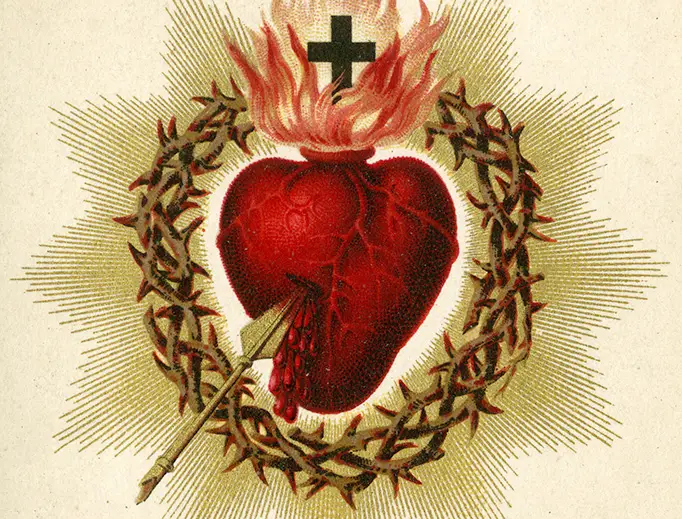
Look carefully at the image. The Heart is wounded. The Heart is crowned with thorns. The Heart burns with fire. This is not the image of a comfortable love. This is the image of a love that gives itself completely.
The Sacred Heart reveals that love is not primarily about receiving. Love is about giving. Love is about self-donation. Love is about willing the good of another, regardless of the cost to oneself.
The world often asks, “What can I get?” Love asks, “What can I give?” The world asks, “How does it make me feel?” Love asks, “What is best for the other person?” The world asks, “What do I deserve?” Love asks, “How can I serve?”
This is why the Sacred Heart remains so important. It rescues love from sentimentality. It rescues love from self-interest. It rescues love from emotion alone. And nowhere is God’s eternal definition of love revealed more clearly than on Calvary.
When we gaze upon the Sacred Heart, we are gazing upon the Heart that led Christ to the Cross. A love that could forgive those who nailed Him there. A love that could pray for His persecutors. A love that could continue giving even while being rejected. A love that remained faithful even unto death.
The Sacred Heart reveals something astonishing. Love is stronger than suffering. Love is stronger than fear. Love is stronger than death itself. And throughout time, that same love has transformed ordinary men and women into saints.
Consider the apostles. Before the Resurrection, they were frightened. When Christ was arrested, they scattered. When danger appeared, they fled. Peter denied even knowing Him. Yet something happened to those men. Something transformed them. The question is what?
The answer is found in the Sacred Heart. They encountered a love unlike anything they had ever known. They came to understand that His love was stronger than their failures, stronger than their weaknesses, stronger than their sins.
The Heart that was pierced for them became the source of their courage. And suddenly the men who once ran away became men willing to die. Not because they became fearless. But because love was greater than fear.
The same pattern appears again and again throughout the history of the Church. Every martyr is a witness to the Sacred Heart. Every martyr is proof that divine love can transform a human life. The martyrs were not people who felt less pain than we do. They were not superhuman. They were not born with extraordinary courage. They were ordinary men and women whose hearts had been set on fire by the love flowing from the Heart of Christ.
When we read the accounts of the early martyrs, we encounter something remarkable. Many faced imprisonment. Many endured torture. Many lost everything. And yet they remained faithful.
Some sang hymns. Some prayed. Some forgave their executioners. Some encouraged fellow Christians who were afraid. Such things made little sense according to the world’s definition of love. But they make perfect sense according to God’s. Because when divine love takes hold of a soul, everything changes.
The Sacred Heart changes people. One cannot truly encounter that love and remain the same. Think of the great martyrs throughout the centuries. Think of those who faced persecution under the Roman Empire. Think of missionaries who crossed oceans knowing they might never return. Think of priests who secretly celebrated the sacraments under threat of death. Think of religious sisters who cared for the sick during epidemics and plagues. Think of countless unnamed Christians who quietly suffered for the sake of Christ.
What sustained them?
The answer was not human determination. Human determination eventually fails. The answer was not mere discipline. Discipline alone cannot sustain a soul through every trial. The answer was love. Not sentimental love. Not emotional love. The love revealed in the Sacred Heart. The eternal definition of love.
Perhaps one of the most striking examples is Joan of Arc. As the flames rose around her, she asked that a crucifix be held before her eyes. What kind of love remains faithful in such a moment? What kind of love endures when everything within the human person cries out for escape? Only divine love. Only the love flowing from the Sacred Heart.
The fire around her was terrible. But there was already another fire burning within her. The fire of Christ’s love. The fire that has burned in the hearts of saints throughout every age. And that is why the Feast of the Sacred Heart matters so much today. Because we are living in a world that desperately needs to rediscover the true meaning of love.
We hear endless talk about love. Yet we see growing loneliness. Growing division. Growing anxiety. Growing confusion. We see families struggling. Communities fragmenting. Faith weakening.
Many people sense that difficult times lie ahead. Whether those difficulties come through suffering, cultural hostility, confusion, persecution, isolation, or simply the challenge of remaining faithful in a rapidly changing world, one thing is certain. The world’s definition of love will not sustain us. Sentiment will not sustain us. Emotion will not sustain us. Comfort will not sustain us. Only the love revealed in the Sacred Heart can sustain us.
The Christians who endure the future will not necessarily be the most talented. They will not necessarily be the most educated. They will not necessarily be the most influential.
They will be the ones who have learned to love as Christ loves. The ones who have allowed the Sacred Heart to shape their own hearts. The ones who remain faithful when fidelity becomes costly. The ones who forgive when forgiveness is difficult. The ones who persevere when perseverance hurts. The ones who continue to love when love requires sacrifice.
The future belongs to those whose hearts beat in union with the Sacred Heart. This is why the saints are so important. The saints are living commentaries on the Sacred Heart. Every saint demonstrates what happens when divine love is allowed to take root in a human soul.
The saints were not transformed primarily by knowledge. They were transformed by love. Knowledge can inform the mind. Love transforms the heart. Knowledge can teach us about God. Love unites us to God. And ultimately that is the purpose of the Sacred Heart. Not merely that we admire it. Not merely that we honor it. Not merely that we place its image in our homes. The purpose of the Sacred Heart is transformation. The Heart of Jesus is presented to us so that our hearts might become like His.
The Church gives us this feast every year because we forget. We forget what love truly is. We forget that love is sacrifice. We forget that love is fidelity. We forget that love is self-gift. We forget that love is willing to suffer for the Beloved. And so Christ shows us His Heart once again.
Wounded.
Pierced.
Crowned with thorns.
Burning with fire.
As if to say, “This is what love looks like.”
On this Feast of the Sacred Heart, perhaps the most important question we can ask is this: What definition of love governs my life? The world’s? Or Christ’s? Do I love only when it is easy? Do I love only when I receive something in return? Do I love only when the feelings are strong? Or have I begun to love as Christ loves? For that is the eternal definition of love. The definition written not in a book but on the Cross. The definition revealed not through words alone but through the Sacred Heart of Jesus.
A love stronger than fear. Stronger than suffering. Stronger than sin. Stronger than death. A love that transformed apostles into saints. A love that transformed saints into martyrs. A love that can transform us as well.
And it is this love – revealed in the Sacred Heart and offered to every soul – that remains humanity’s greatest hope, the Church’s greatest strength, and our eternal destiny.
But perhaps before we conclude, let us make this personal. It is easy to admire the Sacred Heart from a distance. It is easy to look at the saints and martyrs and marvel at their courage. It is easy to speak about divine love in the abstract. The harder question is this: Have I allowed the Sacred Heart of Jesus to transform my own heart?
Not someday. Not when life becomes easier. Not when circumstances improve. Now. Today.
The saints were not transformed in a single moment. They were transformed by daily surrender. Day after day, they allowed the love of Christ to shape their thoughts, their decisions, their priorities, and their actions. That same invitation is extended to each of us.
Perhaps the Sacred Heart is asking one person to forgive. Perhaps another to persevere. Perhaps another to trust. Perhaps another to return to prayer. Perhaps another to return to confession. Perhaps another to love someone who has become difficult to love. Whatever the invitation may be, the Sacred Heart never calls us without also giving us the grace to respond.
And so, on this beautiful Feast of the Sacred Heart, let us ask for one gift. Not success. Not comfort. Not even freedom from suffering. Let us ask for hearts that become more like His. For if our hearts become like His, we will have everything we need. We will have the courage of the martyrs. The fidelity of the saints. The hope that endures in darkness. The peace that survives trials. And the love that is stronger than death.
May the Sacred Heart of Jesus teach us His eternal definition of love. May He purify our hearts of selfishness and fear. May He strengthen us for whatever lies ahead. And may He make each of us a living witness to the love that flows from His Sacred Heart.
And may Almighty God bless you, the Father, and the Son, and the Holy Spirit. Amen.
Bishop Joseph E. Strickland
Bishop Emeritus


