My dear brothers and sisters in Christ,
We are living in a time when the world feels as though it is unraveling before our eyes. Nations rise against nations. Conflicts escalate. Voices grow louder, angrier, more divided. And even among Catholics – among those who should be united in the truth of Jesus Christ – we see confusion, tension, and sometimes even hostility.
In moments like this, many people ask, “Who is right? Which side should I support? What position should I take?”
But before we ask any of those questions, there is a deeper and more important one that must come first: “Are we thinking with the mind of Christ … or with the mind of the world?”
Because if we answer every question about war, justice, and conflict with a worldly mindset – even if we believe we are defending something good – we risk losing something far more important than any earthly victory. We risk losing clarity of soul. We risk losing charity. We risk losing Christ Himself.
There is a question that has surfaced again in recent days – one that many people struggle with, and one that deserves to be faced honestly. It is the question of violence in the history of God’s people. People look at the Old Testament and see wars, commands, battles. And they ask: How do we reconcile this with Jesus Christ?
We must understand that God revealed Himself gradually across salvation history. In the Old Testament, He worked within a specific people, a specific covenant, a specific time. There were moments when war was permitted, even commanded, within that unfolding plan. But those moments were never a universal permission for violence. They were not a model to be copied across all times and places.
And then, in the fullness of time, Jesus Christ comes. And everything is brought into its fullness. Everything is clarified. Everything is judged in the light of Him. And what do we see?
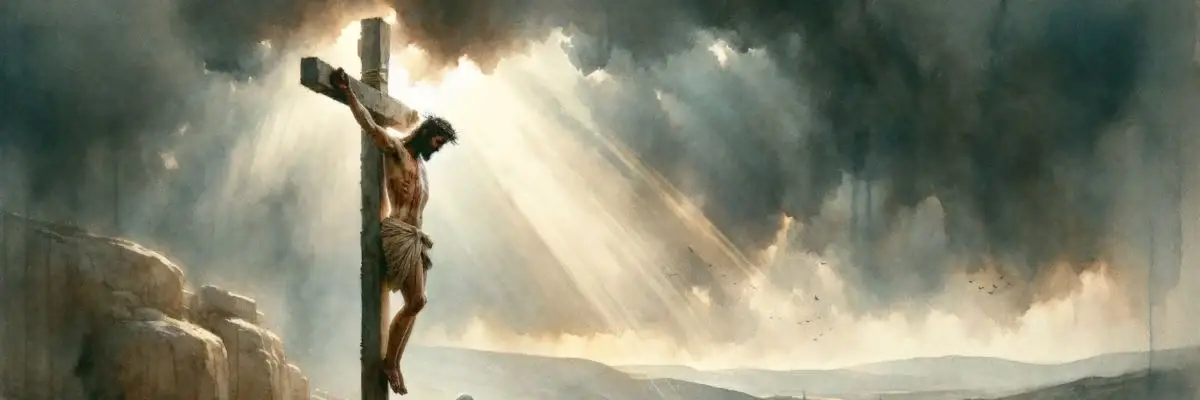
We do not see a king who conquers by the sword. We see a King who conquers by the Cross. We see the Son of God standing before His enemies – not calling down legions of angels, not striking them down – but allowing Himself to be mocked, scourged, and crucified.
We hear His words in the Garden, when one of His own tries to defend Him with violence. “Put up again thy sword into its place: for all that take the sword shall perish with the sword” (Matthew 26:52).
And we hear Him say before Pilate: “My kingdom is not of this world. If my kingdom were of this world, my servants would certainly strive that I should not be delivered to the Jews: but now my kingdom is not from hence” (John 18:36).
This is the turning point. This is the lens through which everything must now be understood. Christ does not conquer by destroying His enemies. He conquers by dying for them. He does not spread His kingdom through domination. He spreads it through sacrifice.
And so we must be very clear: any use of religion to justify hatred, cruelty, or the dehumanization of others is a betrayal of Jesus Christ – no matter who does it, and no matter what cause they claim.
At the same time, the Church, guided by truth and reason, has always recognized that we live in a fallen world. Sin exists. Evil exists. There are times when grave injustice must be restrained. This is where the Church speaks about what has come to be called the “just war” tradition.
But we must be careful here.
The Church does not teach that war is good. The Church does not glorify war. The Church tolerates war under very strict conditions, when it is necessary to restrain serious evil and protect the innocent.
St. Augustine and St. Thomas Aquinas both addressed this, emphasizing that even when war may be permitted, it must always be governed by justice and ordered toward peace.
The Catechism of the Catholic Church teaches that the use of force must meet very strict conditions: there must be a just cause, it must be a last resort, there must be a reasonable chance of success, and the means used must be proportional. But even if all of those conditions are met – and that is a high bar – something very important remains true.
Even when a war may be just, hatred is never just. Even when force may be permitted, vengeance is not. Even when a nation defends itself, the soul of the Christian must remain anchored in charity. And this is where the real danger lies for us today. Because in times of conflict, it is very easy to lose sight of this.
It is very easy to become tribal. To align ourselves completely with one side – not just in justice, but in spirit. To begin to speak about others not as human beings made in the image of God, but as enemies to be despised. To justify attitudes, words, and even desires that are not of Christ. The greatest danger in war is not only what happens on the battlefield. The greatest danger is what happens in the human heart.
A Catholic can lose his soul while defending what he believes to be right … if he loses charity. A Catholic can become spiritually blind while claiming to stand for justice … if he abandons truth and mercy. This is why we must return, again and again, to the Cross. Because the Cross stands above every conflict. The Cross judges every nation. The Cross exposes every sin – on every side. At the Cross, we see the full horror of sin. And we also see the full depth of God’s mercy.
We see that Christ died not only for those we agree with. He died for all. For every nation. For every people. For every soul. And so, if we are to think rightly about war, about justice, about the conflicts of our time, we must stand at the foot of the Cross. Not on one side or the other as the world defines it. But with Christ. Looking at all things through Him.
And from that place, we can begin to understand how we are called to live. We are called to pray – not only for those we identify with, but for all who are suffering. We are called to reject hatred – even when we feel anger. We are called to seek truth – not propaganda, not manipulation, not emotional reaction. We are called to fast and do penance – because the battle is not only external, it is spiritual.
We are called to remain faithful to the Sacraments – to Confession, to the Holy Eucharist – because without grace, we cannot remain rooted in Christ. And we are called to remember that our ultimate allegiance is not to any nation, any political system, or any earthly power. Our allegiance is to Jesus Christ.
There is a temptation in times like these to let the world teach us how to think, how to react, how to feel. But we must resist that temptation. Do not let the world teach you how to feel about war. Let Christ teach you.
Do not let anger shape your heart. Let the Cross shape your heart. Do not let fear guide your thoughts. Let truth guide your thoughts. Because Christ is not absent in these times. He is reigning. He is King – not in spite of the chaos, but even within it. And His kingship is not like the kingship of this world.
The world wins by power. Christ wins by sacrifice. The world seeks victory through domination. Christ reveals victory through love poured out on the Cross. And that is where we must stand. At the Cross. Always at the Cross.
Because if we stand anywhere else – if we stand in pride, in hatred, in blind allegiance, in worldly thinking – we will eventually find ourselves standing not only apart from Christ … but against Him. Let us remain with Him. Let us remain faithful. Let us remain rooted in truth and charity. And let us remember, no matter how dark the world may seem: Christ has already won the victory. And that victory was not won by the sword – but by the Cross. And my dear brothers and sisters, if we are honest, this is where the real battle lies.
It is not only on the fields of war, not only in the decisions of nations, not only in the strategies of leaders. The real battle is within the human heart.
Because long before a weapon is raised, something has already begun to take root in the soul. Long before violence breaks out in the world, there is a turning away from God, a hardening, a loss of charity, a willingness to see another person not as a brother or sister created in the image of God, but as something less. And this is where we must be vigilant.
Because it is very easy to look at the world and say, “There is the problem. There is the evil. There is the danger.” But Our Lord consistently calls us to look first within. He says in the Gospel: “For from within out of the heart of men proceed evil thoughts, adulteries, fornications, murders, thefts, covetousness, wickedness, deceit, lasciviousness, an evil eye, blasphemy, pride, foolishness“ (Mark 7:21-22).
War does not begin on the battlefield. War begins in the human heart. And so if we are going to speak about justice, if we are going to speak about what is right, then we must begin where Christ begins – with the conversion of the heart.
St. Augustine, reflecting on the reality of war and peace, wrote that true peace is not simply the absence of conflict, but the “tranquility of order.” And that order begins when the soul is rightly ordered toward God.
If the soul is disordered, if it is ruled by anger, pride, fear, or hatred, then even what appears to be a just cause can become corrupted.
This is why the Church has always insisted that even when force is used for legitimate defense, it must be governed not only by external conditions, but by an interior disposition rooted in justice and charity. Because without that, everything becomes distorted.
We begin to justify what should never be justified. We begin to excuse what should never be excused. We begin to speak in ways that reflect not the Heart of Christ – but the spirit of the world. And here is something we must say very clearly: No political cause, no national interest, no earthly goal – no matter how serious – can ever give us permission to hate. Hatred is never justified. Contempt for the dignity of another person is never justified. To delight in the suffering of others is never justified.
And yet, if we are not careful, we can find ourselves drifting in that direction, little by little, word by word, thought by thought. That is why we must stay close to the Cross. Because at the Cross, everything is purified. At the Cross, we see what sin really does. At the Cross, we see what love really is. At the Cross, we are reminded that every person – every single person – is someone for whom Christ shed His Precious Blood.
Not just those we agree with. Not just those who belong to our nation. Not just those who share our beliefs. But all.
And this does not mean we abandon truth. It does not mean we pretend that evil does not exist. It does not mean we refuse to acknowledge injustice or the need to resist it. But it does mean that we resist evil as Christ did. With truth. With clarity. With courage.
But never with hatred. Never with a loss of charity. Never with a spirit that forgets the dignity of the human soul.
My dear brothers and sisters, one of the great dangers of our time is that people are being formed more by the constant stream of information around them than by the Gospel itself. We hear voices all day long – news, commentary, analysis, opinion – and it begins to shape how we think, how we react, how we judge. And if we are not careful, we can begin to respond to the events of the world not as Catholics, but as participants in a worldly conflict.
We begin to speak the language of the world. We begin to think in categories that are not rooted in Christ. We begin to react without prayer, without reflection, without discernment. And slowly, almost without realizing it, we drift. This is why we must be intentional. We must be deliberate. We must choose to remain rooted in Christ.
That means prayer – real prayer, not just words, but time spent with God. That means the Sacraments – Confession, where our hearts are cleansed; the Holy Eucharist, where we are united to Christ Himself.
That means fasting and penance – because we must not forget that the struggles we see in the world are also spiritual in nature.
St. Paul reminds us: “For our wrestling is not against flesh and blood; but against principalities and powers … “ (Ephesians 6:12).
If we forget that, we will misunderstand everything. We will begin to treat human beings as the ultimate enemy. And that is never true. The enemy is sin. The enemy is the rejection of God. The enemy is the darkness that seeks to divide, to destroy, to pull souls away from truth and from salvation.
And so we must fight – but we must fight rightly. We must fight as Christians. We must fight with the weapons that Christ has given us. Prayer. Truth. Charity. Sacrifice. Fidelity.
And above all, we must remain faithful to Him. Because no matter what happens in the world – no matter how unstable things may seem, no matter how intense the conflicts may become – this truth remains unshaken: Christ is King. He is not a distant observer. He is not absent. He reigns. Even now. And His victory has already been won.
Not through force. Not through domination. But through the Cross.
And so we do not respond with fear. We do not respond with hatred. We do not respond by losing ourselves in the chaos of the world. We respond by drawing closer to Him. By standing firm in truth. By remaining rooted in charity. By refusing to let anything – anything – separate us from the mind and the Heart of Jesus Christ.
Because in the end, that is what will matter. Not which side we chose in a worldly conflict. But whether we remained faithful to Christ. Whether we loved as He loved. Whether we stood at the Cross. And remained there.
May Almighty God bless you, in the name of the Father, and of the Son, and of the Holy Ghost. Amen.
Bishop Joseph E. Strickland
Bishop Emeritus